Reporters
Docs for Vitest SDK v0.3.3
LiveDoc provides reporters that transform raw Vitest results into beautiful, structured output — from colored CLI output to JSON exports and real-time web visualization.
// vitest.config.ts
import { defineConfig } from "vitest/config";
import { LiveDocSpecReporter } from "@swedevtools/livedoc-vitest/reporter";

export default defineConfig({
  test: {
    reporters: [
      new LiveDocSpecReporter({
        detailLevel: "spec+summary+headers",
      }),
    ],
  },
});
Reference
LiveDocSpecReporter
The primary reporter. Formats test results in Gherkin-style CLI output with features, scenarios, and steps — and automatically discovers a running LiveDoc server for real-time visualization.
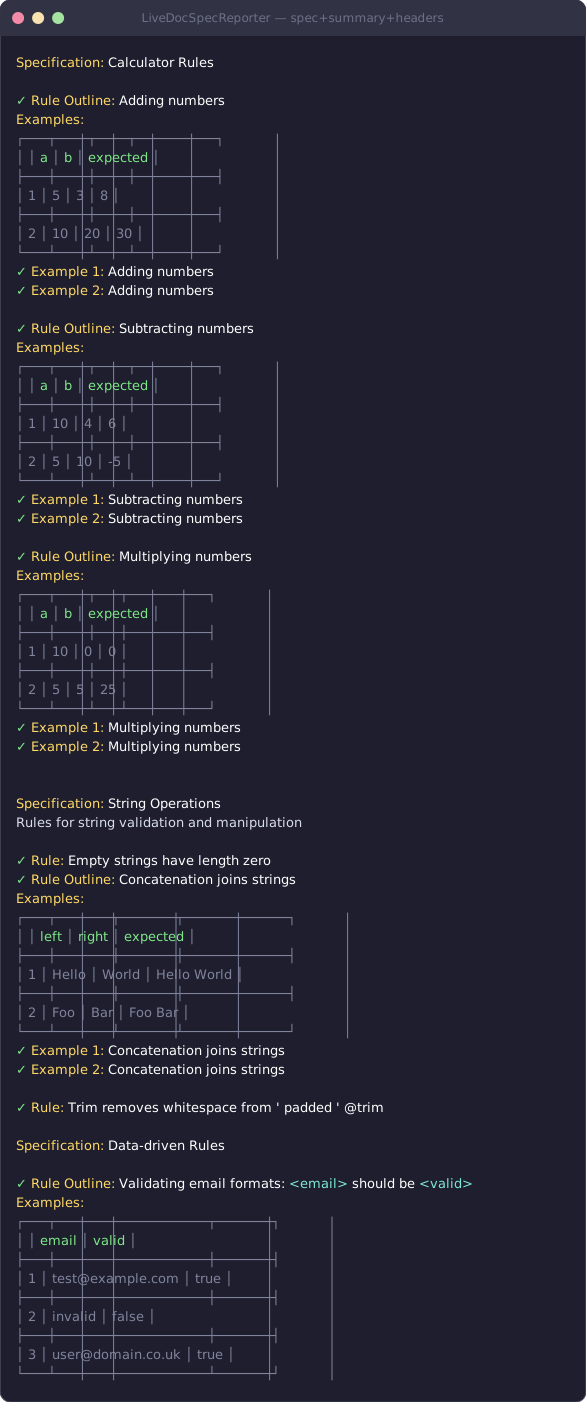
import { LiveDocSpecReporter } from "@swedevtools/livedoc-vitest/reporter";

new LiveDocSpecReporter(options?: LiveDocSpecReporterOptions)
As of v0.1.6, LiveDocSpecReporter handles both console output and server auto-discovery. You no longer need a separate LiveDocServerReporter — just add LiveDocSpecReporter and it will automatically find and publish to a running LiveDoc server.
Options
| Option | Type | Default | Description |
|---|---|---|---|
detailLevel | string | "spec+summary+headers" | Controls what is displayed. Combine flags with +. |
output | string | undefined | File path to write output (in addition to console). |
removeHeaderText | string | undefined | Prefix to strip from file paths in headers (useful for monorepos). |
colors | boolean | true | Enable/disable ANSI colors in output. |
postReporters | PostReporter[] | [] | Additional reporters to run after test completion. |
json-output | string | undefined | File path for JSON output (used with JsonReporter). |
publish | object | undefined | Explicit server publish configuration (see below). |
export | object | undefined | Write a TestRunV1 JSON file to disk (see Export Options). |
coverage | object | undefined | Attach coverage evidence and optional thresholds. Requires a Vitest coverage provider. |
Auto-Discovery
When LiveDocSpecReporter initializes, it automatically attempts to find a running LiveDoc server using the following priority:
- Environment variables —
LIVEDOC_SERVER_URLorLIVEDOC_PUBLISH_SERVER - Explicit
publishconfig —livedoc.options.publishin your vitest config discoverServer()fallback — dynamically imports@swedevtools/livedoc-serverto probe for a running server- Default local viewer — probes
http://localhost:3100/api/health
If no server is found, the reporter silently continues with console-only output — your tests always run normally.
Use LIVEDOC_PROJECT and LIVEDOC_ENVIRONMENT to control where the run appears in the viewer.
Publish Options
To explicitly configure server publishing instead of relying on auto-discovery:
new LiveDocSpecReporter({
  detailLevel: "spec+summary+headers",
  publish: {
    enabled: true,
    server: "http://localhost:3100",
    project: "my-project",
    environment: "local",
  },
})
| Option | Type | Default | Description |
|---|---|---|---|
publish.enabled | boolean | false | Enable server publishing |
publish.server | string | undefined | Server URL |
publish.project | string | "livedoc" | Project name for grouping results |
publish.environment | string | "local" | Environment label |
publish.runType | "full" | "partial" | "full" | Publish a complete baseline or focused partial update |
Coverage Options
Install @vitest/coverage-v8 at the same version as Vitest, enable Vitest
coverage, and set coverage.enabled on the reporter:
new LiveDocSpecReporter({
  coverage: {
    enabled: true,
    thresholds: {
      lines: 80,
      branches: 75,
    },
  },
})
| Option | Type | Default | Description |
|---|---|---|---|
coverage.enabled | boolean | false | Expect and publish coverage evidence |
coverage.path / coverage.artifactPath | string | Auto-detect | Custom JSON summary or LCOV artifact |
coverage.thresholds | Partial<Record<"lines" | "branches" | "functions" | "statements", number>> | None | Non-fatal Viewer warnings |
See Code Coverage for the complete runner configuration and dependency matrix.
Export Options
Write a TestRunV1 JSON file directly to disk after each test run — no server needed. This is the recommended approach for CI pipelines and for feeding the static HTML export.
new LiveDocSpecReporter({
  detailLevel: "spec+summary+headers",
  export: {
    output: "./test-results/livedoc-report.json",
  },
})
| Option | Type | Default | Description |
|---|---|---|---|
export.output | string | "./test-results/livedoc-report.json" | File path for the JSON output. Directories are created automatically. |
export.project | string | Publish config or "livedoc" | Project name embedded in the JSON. Falls back to publish.project. |
export.environment | string | Auto-detected | Environment label. Falls back to publish.environment, then auto-detects ("ci" when CI env var is set, "local" otherwise). |
The export option writes a file in addition to console output and server publishing — it doesn't replace either. You can use export, publish, and postReporters together.
On completion the reporter prints a confirmation with the file size:
✅ LiveDoc results exported to ./test-results/livedoc-report.json (1.2 MB)
The exported JSON file can be used with livedoc-viewer export to generate a self-contained HTML report, or consumed by any tool that reads the TestRunV1 schema.
Detail Level Flags
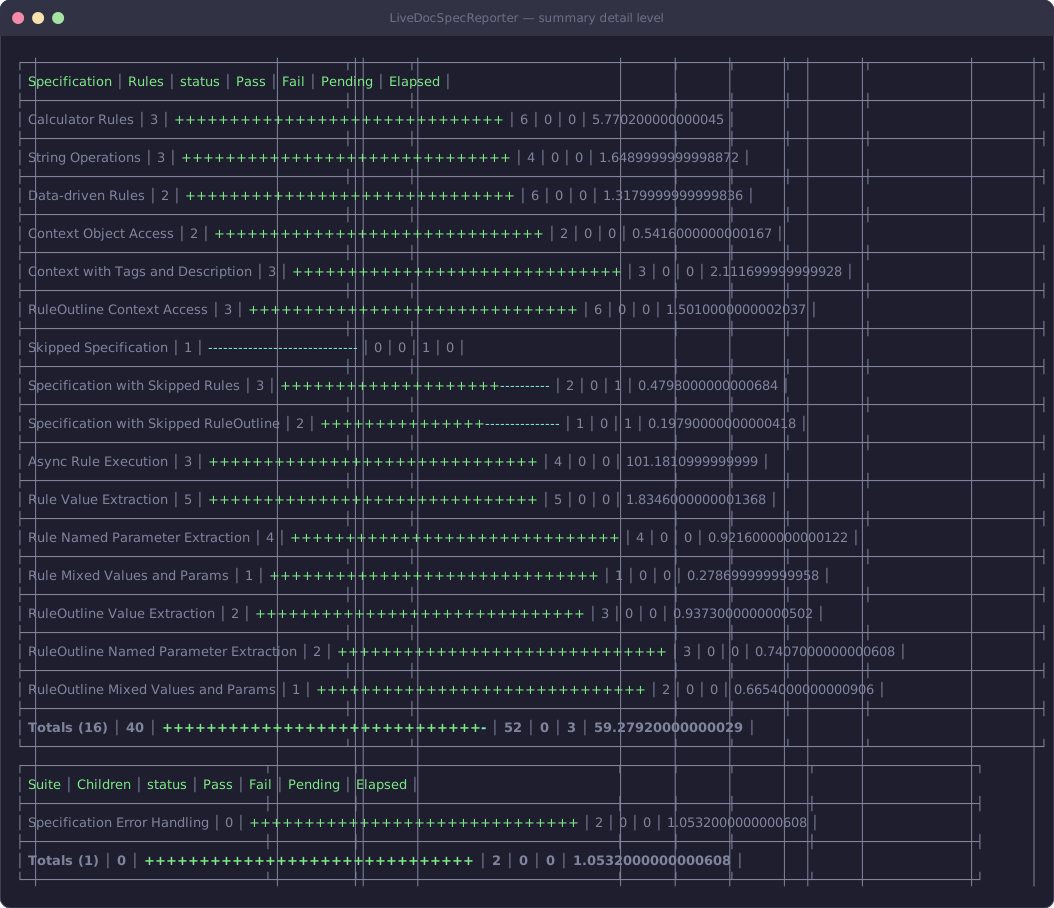
Combine flags with + to control output verbosity.
Summary detail level:
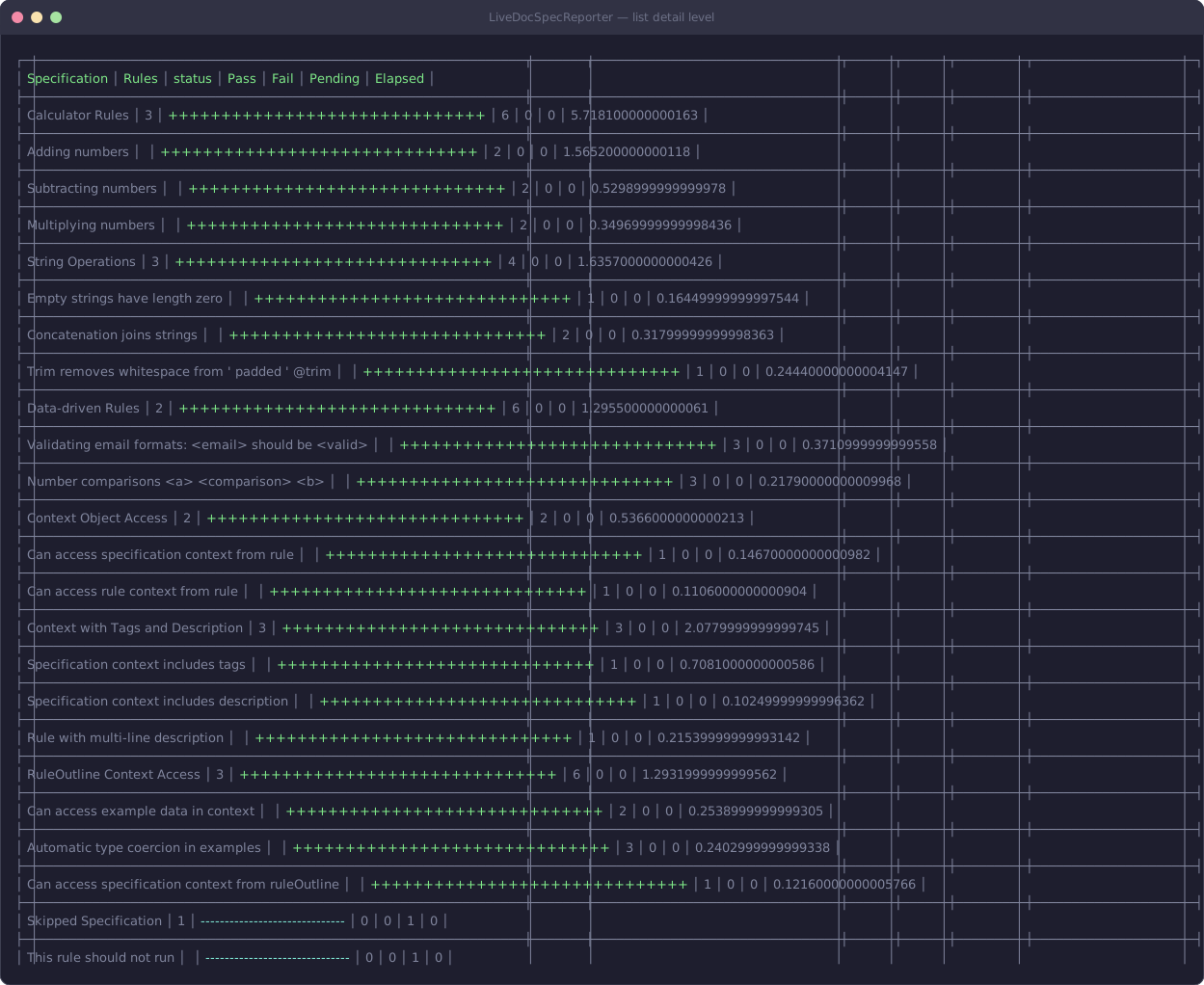
List detail level (with individual rule/scenario results):
| Flag | Description |
|---|---|
spec | Show individual steps with pass/fail status |
summary | Show totals summary at the end |
headers | Show feature and scenario names |
list | Compact list format |
auto | Automatic detail level based on test count |
silent | No console output (useful when only using post-reporters) |
Common combinations:
// Full output (default) — show everything
detailLevel: "spec+summary+headers"

// Summary only — just totals
detailLevel: "summary"

// Headers and summary — no individual steps
detailLevel: "headers+summary"

// Silent — only post-reporters produce output
detailLevel: "silent"
Console Output Example
Feature: Shopping Cart  @ecommerce

  Scenario: Adding an item
    ✓ given an empty cart
    ✓ when the user adds a product
    ✓ then the cart contains 1 item

──────────────────────────────────────────────────────
LiveDoc Test Summary
  ✓ 3 steps passed
  1 feature, 1 scenario, 3 steps
JsonReporter
Post-reporter that writes test results to a JSON file. Used as a postReporter inside LiveDocSpecReporter.
import { LiveDocSpecReporter, JsonReporter } from "@swedevtools/livedoc-vitest/reporter";

new JsonReporter()
Configuration
The JSON output file path is set via the json-output option on LiveDocSpecReporter:
new LiveDocSpecReporter({
  detailLevel: "spec+summary+headers",
  postReporters: [new JsonReporter()],
  "json-output": "./livedoc-results.json",
})
JSON Output Contents
The JSON file includes:
- All features with their scenarios and steps
- All specifications with their rules
- Pass/fail status and execution timing
- Error messages and stack traces
- Tags and metadata
LiveDocViewerReporter
Post-reporter that sends test results to a LiveDoc Viewer web UI via HTTP POST.
import { LiveDocViewerReporter } from "@swedevtools/livedoc-vitest/reporter";

new LiveDocViewerReporter(options?: LiveDocViewerOptions)
Options
| Option | Type | Default | Description |
|---|---|---|---|
server | string | "http://localhost:3100" | Viewer server URL |
project | string | "livedoc" | Project name for grouping results |
environment | string | "local" | Environment label (e.g., "local", "ci") |
timeout | number | 5000 | HTTP request timeout in milliseconds |
silent | boolean | true | If true, fails silently when server is unavailable |
Example
import { LiveDocSpecReporter, LiveDocViewerReporter } from "@swedevtools/livedoc-vitest/reporter";

new LiveDocSpecReporter({
  detailLevel: "spec+summary+headers",
  postReporters: [
    new LiveDocViewerReporter({
      server: "http://localhost:3100",
      project: "my-project",
      environment: "local",
    }),
  ],
})
LiveDocServerReporter (deprecated)
LiveDocServerReporter is now a re-export of LiveDocSpecReporter. Auto-discovery is built into LiveDocSpecReporter — you no longer need a separate reporter. Existing configs that use LiveDocServerReporter will continue to work, but you can simplify by removing it.
Previously a standalone reporter for auto-discovering a running LiveDoc server. This functionality is now built directly into LiveDocSpecReporter.
Old config (still works, but unnecessary):
import { LiveDocSpecReporter } from "@swedevtools/livedoc-vitest/reporter";
import LiveDocServerReporter from "@swedevtools/livedoc-vitest/reporter";

reporters: [
  new LiveDocSpecReporter({ detailLevel: "spec+summary+headers" }),
  new LiveDocServerReporter(), // ← No longer needed
],
New simplified config:
import { LiveDocSpecReporter } from "@swedevtools/livedoc-vitest/reporter";

reporters: [
  new LiveDocSpecReporter({ detailLevel: "spec+summary+headers" }),
  // Auto-discovery happens automatically — no second reporter needed
],
Usage
Basic: CLI output only
// vitest.config.ts
import { defineConfig } from "vitest/config";
import { LiveDocSpecReporter } from "@swedevtools/livedoc-vitest/reporter";

export default defineConfig({
  test: {
    reporters: [
      new LiveDocSpecReporter({
        detailLevel: "spec+summary+headers",
      }),
    ],
  },
});
CLI with TestRunV1 export for CI
Export a TestRunV1 JSON file for CI artifact upload or static HTML export:
// vitest.config.ts
import { defineConfig } from "vitest/config";
import { LiveDocSpecReporter } from "@swedevtools/livedoc-vitest/reporter";

export default defineConfig({
  test: {
    reporters: [
      new LiveDocSpecReporter({
        detailLevel: "spec+summary+headers",
        export: {
          output: "./test-results/livedoc-report.json",
        },
      }),
    ],
  },
});
CLI with SDK-model JSON export (JsonReporter)
The JsonReporter writes the raw LiveDoc SDK model to a JSON file. This is useful for custom tooling but is not the same format as TestRunV1.
// vitest.config.ts
import { defineConfig } from "vitest/config";
import { LiveDocSpecReporter, JsonReporter } from "@swedevtools/livedoc-vitest/reporter";

export default defineConfig({
  test: {
    reporters: [
      new LiveDocSpecReporter({
        detailLevel: "spec+summary+headers",
        postReporters: [new JsonReporter()],
        "json-output": "./livedoc-results.json",
      }),
    ],
  },
});
Full stack: CLI + JSON + Viewer
// vitest.config.ts
import { defineConfig } from "vitest/config";
import {
  LiveDocSpecReporter,
  JsonReporter,
  LiveDocViewerReporter,
} from "@swedevtools/livedoc-vitest/reporter";

export default defineConfig({
  test: {
    reporters: [
      new LiveDocSpecReporter({
        detailLevel: "spec+summary+headers",
        postReporters: [
          new JsonReporter(),
          new LiveDocViewerReporter({
            server: "http://localhost:3100",
            project: "my-project",
            environment: "local",
          }),
        ],
        "json-output": "./livedoc-results.json",
      }),
      // LiveDocSpecReporter auto-discovers a running LiveDoc server —
      // no separate LiveDocServerReporter needed
    ],
  },
});
Output to file for CI logs
// vitest.config.ts
import { defineConfig } from "vitest/config";
import { LiveDocSpecReporter } from "@swedevtools/livedoc-vitest/reporter";

export default defineConfig({
  test: {
    reporters: [
      new LiveDocSpecReporter({
        detailLevel: "spec+summary+headers",
        output: "./test-output.txt",
      }),
    ],
  },
});
VS Code–safe configuration
The VS Code Vitest extension can conflict with custom reporters. Detect the environment and fall back:
// vitest.config.ts
import { defineConfig } from "vitest/config";
import { LiveDocSpecReporter } from "@swedevtools/livedoc-vitest/reporter";

const isVSCodeVitest = !!(
  process.env.VITEST_VSCODE ||
  process.env.VSCODE_PID ||
  process.env.VSCODE_IPC_HOOK
);

export default defineConfig({
  test: {
    reporters: isVSCodeVitest
      ? undefined
      : [
          new LiveDocSpecReporter({
            detailLevel: "spec+summary+headers",
          }),
        ],
  },
});
Monorepo path cleanup
Strip path prefixes from file headers for cleaner output in monorepos:
new LiveDocSpecReporter({
  detailLevel: "spec+summary+headers",
  removeHeaderText: "packages/",
})
// Before: packages/auth/tests/Login.Spec.ts
// After:  auth/tests/Login.Spec.ts
See Also
- Configuration — full
vitest.config.tsreference - Guide: CI/CD Integration — using reporters in continuous integration
- Guide: Static HTML Export — generate shareable HTML reports from exported JSON
- Guide: Viewer Integration — setting up the LiveDoc Viewer
- Guide: Custom Reporters — building your own reporter